


It’s a tale as harrowing as it is realistic. A Russian-designed superweapon derived from plague, genetically engineered to encourage gregariousness to maximize spread before killing its host with top lethality, is released after an explosion at Russia’s premier “biodefense” facility. This novel plague rapidly spreads throughout the world thanks to the speed of air travel. Then, missed signals by U.S. government officials, poor coordination from too many overlapping institutions, and the unexpected behavior of the new pathogen lead to hundreds of millions of American deaths. We’re left wondering whether the U.S. government can even reconstitute itself.
Annie Jacobsen’s latest salvo is Biological War: A Scenario, a speculative but true-to-life thriller whose world is even more despairing and dystopian than her previous bestselling work from 2024, Nuclear War: A Scenario. The duo highlights a challenging equilibrium about risk: is it better to confront a known but terrible threat or one that’s profoundly ambiguous but has more potential for solution?
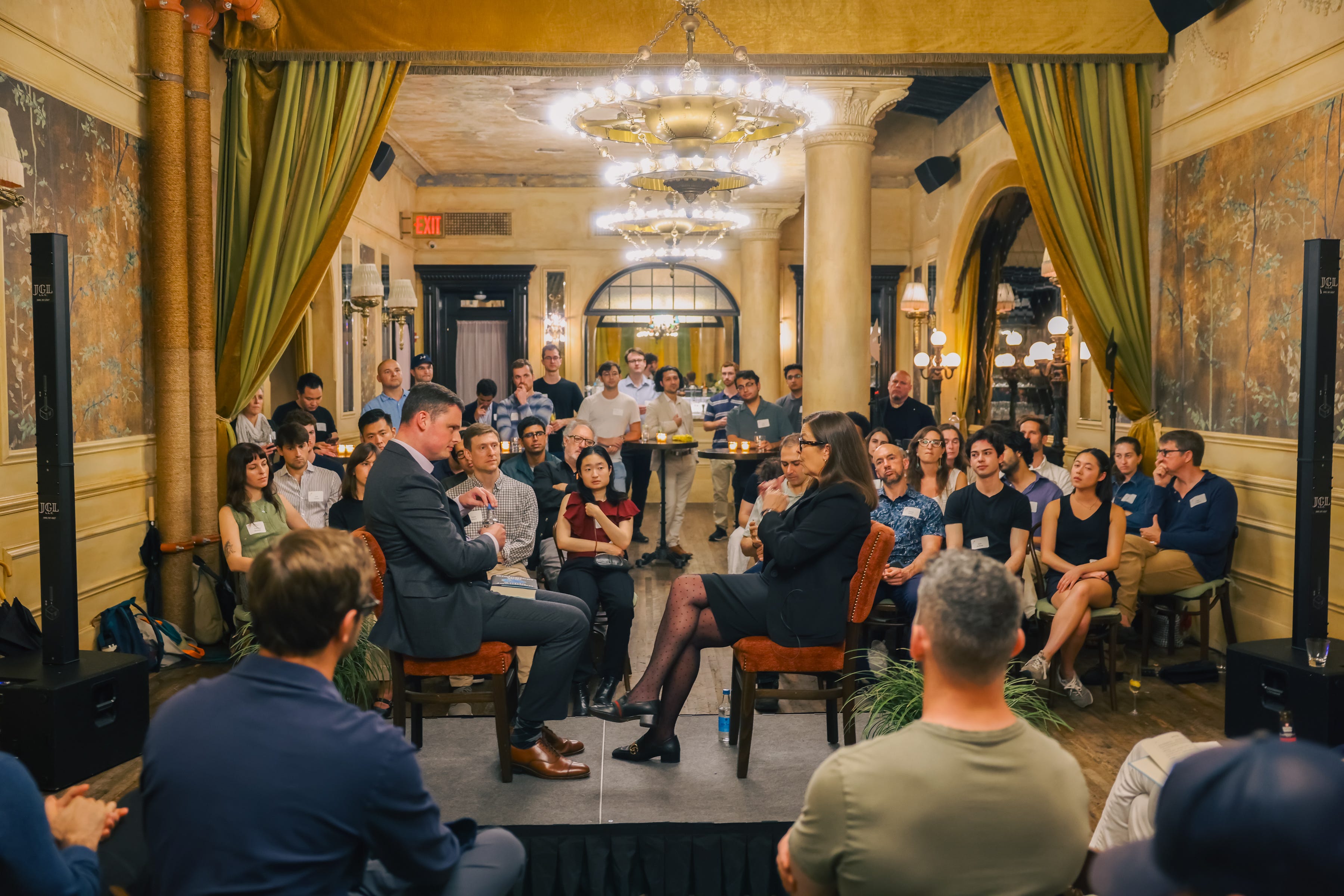
In Nuclear War, the story is about America’s race against time (about 30 minutes) to determine whether a missile launch from North Korea is real and what’s in its payload. Only nine countries are confirmed to have nuclear weapons, and discounting allies, that leaves just a handful of sources for a nuclear attack. As a consequence, the U.S. government has a highly organized set of institutions designed to rapidly assess the threat America is dealing with.
The structure of the crisis affords Jacobsen the ability to travel all over the globe, from Alaska-based monitoring stations designed to scan for intercontinental ballistic missiles to command-and-control infrastructure in Cheyenne Mountain and ultimately onto the Boeing E-4 “doomsday plane” that can continue flying even after the electromagnetic pulse from a nuclear bomb has disabled most other electronics. For laypeople and perhaps even some experts, learning about the extensive layering of these institutions is half the fun of the book.
Two interesting observations about nuclear war emerge. One is that almost no Americans will know that a nuclear war has started until the mushroom clouds expand over our heads. It takes about half an hour for a missile launched from North Korea to reach the West Coast. Even assuming the most aggressive transparent communications to the public at a time of peak crisis (hint: not likely), few would have time to escape the blast radius.
Fundamentally then, nuclear war is an elites-only affair. Only a handful of people in government, most notably the president and the secretary of defense, will have any influence on decision-making. The most important decisions will be whether and how to respond, choices that can’t be reversed once made. Indeed, much of the drama of Jacobsen’s Nuclear War comes from the alacrity of that crucial call: on the move to escape the attack, the president will have mere minutes to decide whether to completely destroy Earth — or potentially lose the ability to make that decision entirely, the so-called “use it or lose it” doctrine of nuclear statecraft.
Second, as scary as Jacobsen’s scenario and its ramifications are (an attack on California’s Diablo Canyon nuclear power plant and its associated fallout is a unique part of her story), it is a clear and linear narrative. The military, which would have pretty much exclusive jurisdiction over a nuclear crisis, is extremely well-prepared in terms of both training and instruments to act when a missile launches and approaches CONUS, the continental United States. It’s a threat that is well-understood and limited in scope, even if its implications are disturbing.
Almost no Americans will know that a nuclear war has started until the mushroom clouds expand over our heads.
By contrast, there is no certainty or specificity for a biological war, or even just a naturally occurring pandemic. We have no idea what pathogens will come, where they will come from, how they will transmit themselves, or whether they will be detectable. Even if we begin to answer these questions, we’ll face very challenging judgment calls on what actions to take. Even now, years after Covid-19 was first detected, there are still active public health debates on what measures were effective and which were bunk. Meanwhile, millions of people died.
Notice the shift here. In nuclear war, the intellectual debate comes before the war. The point is to deter America’s adversaries from starting one to begin with. If nuclear war starts, what happens next is quite circumscribed — so circumscribed, in fact, that the president’s options are written on a plastic credit card called the “biscuit.” With biological war, every stage of the unfolding tragedy is open to vehement debate and tough decisions, and the evidence at hand will necessarily be contradictory and incomplete.
Thus, Jacobsen has a massive challenge on her hands for her new book: her nuclear scenario’s linear and concrete narrative has been replaced by a network of radically uncertain threads, all of which unspool in stochastic ways. No two pandemics are alike, but all nuclear wars would be pretty much the same. With just a bit of exaggeration, it doesn’t matter in Nuclear War if North Korea’s missile is replaced by a Chinese missile, since the response playbook is pretty much the same.
That makes Jacobsen’s choices about the story in Biological War much more consequential. Among a massive universe of options, she chooses to emphasize maximum carnage in her framing. For most people, the default step to avoid a new disease is to limit contact with others. That behavior would have vastly limited the casualties in Biological War, and so to correct for this, Jacobsen emphasizes that the novel plague is really a bioweapon chimera, combining two different diseases through genetic engineering to boost its effectiveness. The plague induces euphoria in its victims before eventually killing them, massively increasing the ultimate death toll. That’s certainly fine as a plot choice, although I find it an extreme scenario.
Nuclear War’s strength was showing how information would be collected by the military and presented to the president for decision. With Biological War, Jacobsen seems inspired by Covid-19’s failures to highlight the ineptitude of public health responses in America. Substituting for the military’s precision in identifying a missile is the corrupt Los Angeles Department of Public Health, whose largess and stupidity apparently knows no bounds.
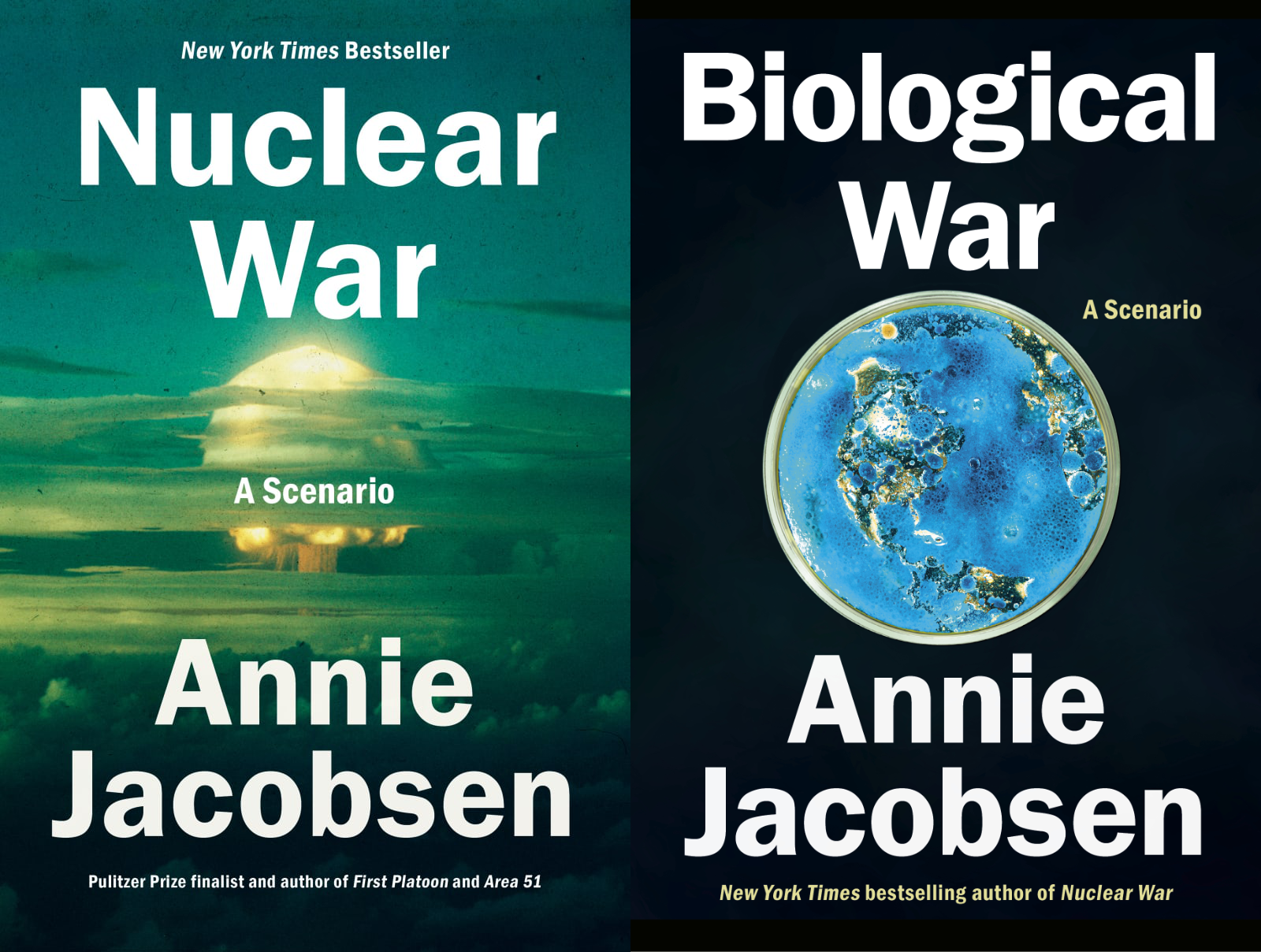
How fair is this? Investigating a novel pathogen is really hard even with the best institutions. Is it airborne and rapidly transmitted? How long is the incubation period? Are symptoms confabulated with other diseases? (In Jacobsen’s plot, there is massive confusion over whether the novel plague is a particularly bad incident of fentanyl overdosing). Are there drugs that offer cures, or can new ones be rapidly developed? The crispness of Jacobsen’s plotting undermines the central ambiguity of what is, ultimately, the enterprise of science — figuring out something we have never seen before and characterizing it.
She’s right that many public health decisions are made at the county level. The upshot of that decentralized model though is that there are thousands of county public health departments, and thus, the best work at just a few of them can be rapidly disseminated all across America. Maybe LA’s is a mire, but other departments will do the necessary work. Yet, we never see in Biological War the thousands of independent institutions that would be working in parallel to solve such a crisis.
That narrowness shows up again with how Jacobsen approaches the response to her imagined catastrophe. Public health is a massive system of tradeoffs in the Riskgaming tradition. Limited resources, limited time, multiple overlapping and contradictory goals all converge on a set of decision-makers, each of whom has their own motivations. Unlike nuclear war, which is an elites-only business, a pandemic involves tens of thousands of mayors, governors, public health officials, hospital execs, laboratory directors and more, plus the actions of the entire general public. In fact, there was even a doctrine developed during the Clinton administration that called for nuclear weapon strikes on offensive bioweapon institutions, since only the maelstrom of the mushroom cloud would be sufficient to kill all specimens (what a nice crossover tale!)
The tradeoffs and complex equilibria have always made bioweapons much more interesting to me than nuclear war.
All of this parallel uncertainty doesn’t fit well with Jacobsen’s “scenario” format, since a nonlinear set of tradeoffs can’t be grafted onto her linear plot. So instead, we get the occasional snatch of dialogue highlighting a key debate. Unfortunately, these are often used more for comedic effect than for showcasing profound complexity.
Take one example when knowledge of the pandemic is starting to induce terror in the population. The president decides to suspend the internet because of the risk of Russian disinformation and the scale of rioting videos showing up in social media feeds. Sure, he has that power, but that decision includes no counterpoint about the importance of the internet in transmitting information between scientists in their scramble to understand a new pathogen and find a cure. One of the miracles of Covid-19 was the demonstration of just how fast the scientific community can instantly collaborate on a global challenge and make serious headway.
There are other tradeoffs that are fundamental to epidemiology that make no appearance. Russia’s novel plague has the benefit of being both highly viral as well as massively and rapidly lethal. In reality, this is often a more balanced relationship: the more lethal a pathogen is and the faster it kills its host, the much less viral it can be. After all, the host is dead and transmission is more limited. The highest fitness pathogens that emerge from nature tend to have been selected for an optimal balance between the two. It’s a very open debate whether genetic engineering can outdo nature, a debate that could have been engaged with but isn’t.
These tradeoffs and complex equilibria have always made bioweapons much more interesting to me than nuclear war. With the latter, there are endless tables of game theoretic models to try to prove deterrence, demanding mathematical precision regarding the destruction of the planet. Bioweapons are the complete opposite. Science, social networks, political and economic dynamics plus luck all converge to radically change the outcome. It’s messy and it’s complicated, but there are so many affordances that can be used to potentially make the situation better or worse. In short, there’s serious agency for most of us.
That’s why it was striking to me how dark Jacobsen’s story choices were. Pages and pages are devoted to riots that develop as Americans race with their guns to hospitals, trying to kill their way to an antibiotic or other cure. Nowhere in the tale is a single sign of solidarity, which is fascinating given how tightly the book wraps its stories up with headlines from Covid-19. Yes, the novel plague is much worse, but it’s profoundly nihilistic to assume that everyone immediately starts murdering each other in a fitful pique of survivalist rage. In reality, outcomes for the same disease can vary tremendously from place to place and between social groups. Individuals have agency, and that is missing from Biological War.
As a final brief aside, while I understand the desire to focus on human health, the more interesting angle (and something we explored in the story for Experimental Automata and in a podcast episode), is the risk of agricultural biowarfare. The same Russian labs that devised horrific bioweapons targeting humans (both in the book and in real life) also designed weapons designed to eliminate American sources of sustenance, most notably wheat. That’s a tale that could have brought in far less familiar politics to Jacobsen’s much wider readership. Hopefully another scenario will be in the offering.
Jacobsen’s goal with both books is to warn the public about the epic dangers that come from weapons of mass destruction. On that count, she has succeeded with aplomb. If Nuclear War is the only book you read on the subject, that’s probably enough. But Biological War is just scratching the surface of the complexities of pandemic preparation, response and recovery. What’s scarier isn’t the advent of a Russian super-pathogen terrorizing society. It’s that even a relatively innocuous pathogen can still cause massive collateral damage to a society. We remain as unprepared as ever for that implication.
Also check out
Our newest Riskgaming scenario from Laurence Pevsner dubbed Four Forks. Play it online in 5 minutes. Decide the future of AI.
The Atlantic gets in on gaming, too. In “Lemony Snicket’s Suspicious Incident in Dubious Park,” you’re an investigator trying to solve the murder of a famous socialite.
Researchers posit that surprise will be the key to advancing science.
A rocket designer with a dubious past sets out to build a missile shield with Europe.
A multimillion-dollar data center heist. And no, I’m not talking about Kathy Hochul.
The CIA operative who helped the UAE win on AI.
Haaretz reveals the Israeli plot to get Ahmadinejad back in power.
The Wagner Group’s opioid empire in Africa.
Fair and kind review, thanks for sharing.
During Covid, someone told me that disease transmission depends on two things: 1) how dense a population is, and 2) how dense a population is (excuse the British slang). That human element seems to be the real “drama” in biowarfare, making it fascinating to read about—endless possibilities for how outcomes will evolve based on the self-important decisions of others. It makes determining how a pathogen might biologically evolve seem much “cleaner” by comparison. Got me thinking about what my next read should be!