


If there’s a North Star for Silicon Valley’s founders, it may very well be Damien Chazelle’s movie Whiplash. In it, an enthusiastic jazz drummer is recruited by a conductor named Terence Fletcher, whose exacting standards are enforced through temper, toxicity and sadism. Fletcher sets the bar ever higher, making the fall back to ground ever more punishing. He ultimately pushes our protagonist well beyond the breaking point, with all of the physical and mental scars to show for it. It’s a shattering film, but one that’s ambiguous, at least for the ambitious: our protagonist becomes a superb jazz drummer. He’s made it. Was all of that punishment worth it in the end? Was it necessary?
As I was reading through a selection of recent books on China’s tech rise, I kept returning to the questions posed by Whiplash, but scaled from a single student and his teacher to the second most populous country on Earth. Hundreds of millions of migrant laborers sacrificed and suffered through hardships all but unknown in the developed West to make China what it is today. Even as the country has reached ever higher rungs of the development ladder though, the pain of competition has only seemed to intensify.
Reviewed in this essay:
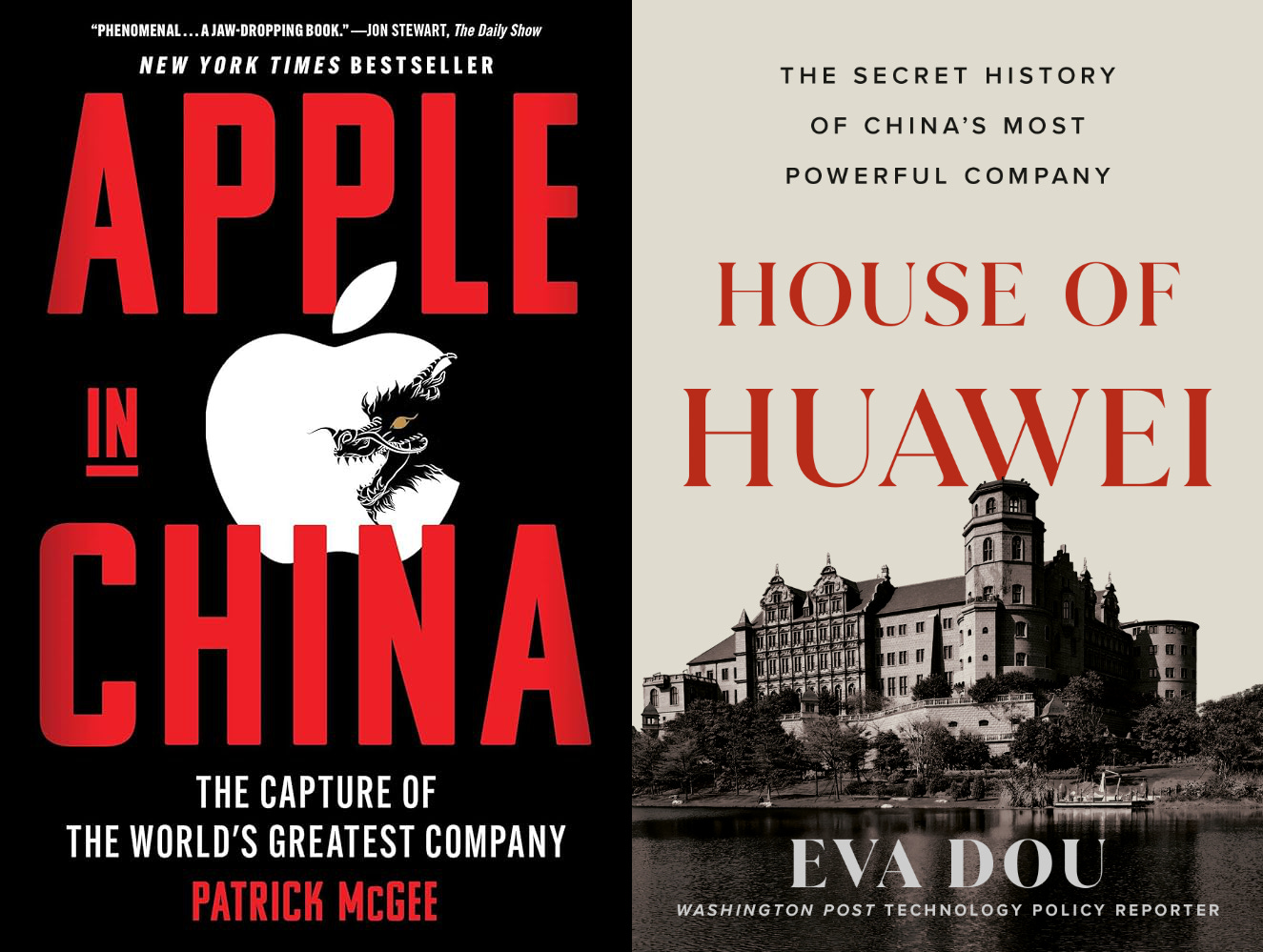
House of Huawei by Eva Dou
Apple in China by Patrick McGee
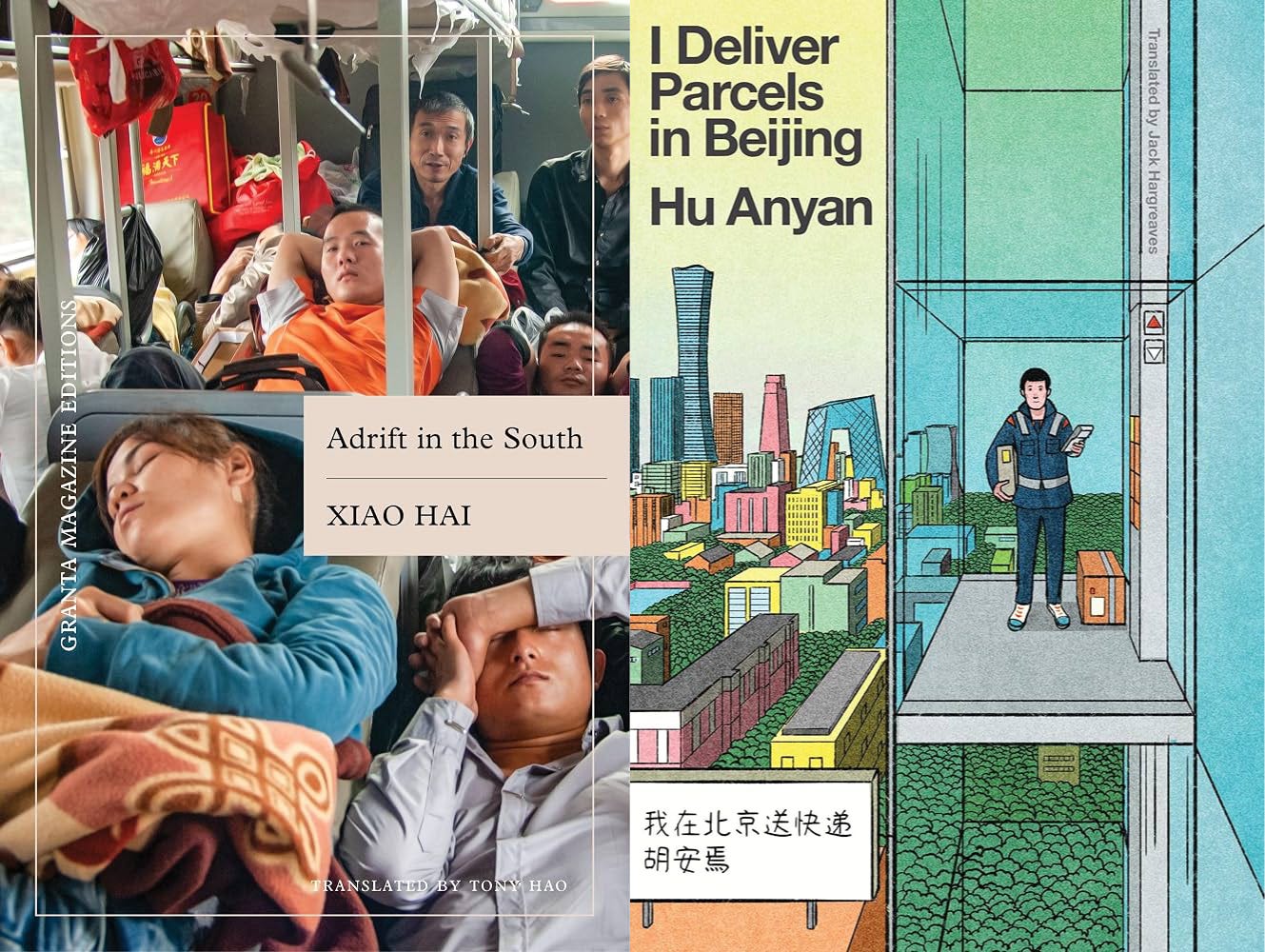
Adrift in the South by Xiao Hai
I Deliver Parcels in Beijing by Hu Anyan
Industrial policy is a brilliant parlor game for the intelligentsia, where every doctor-but-not-the-kind-that-helps-people can piss their favorite social science theory into the punchbowl. Read 1,000 papers and monographs, and a simple truth emerges: there are no shortcuts nor stratagems that can suddenly take a naif to greatness, or a poor country to the apex of power. It’s just work, debilitatingly hard work. The kind of hard work that leads to missing limbs, shattered lives, suicides and excruciating pain as one gropes inexorably forward to end the suffering. The Chinese don’t call it eating bitterness for nothing, but what, truly, is the alternative?
A second truth emerges though. Apologies to GiveDirectly and the other EA 10% folks, as well as the United Nations Cinematic Universe of six-letter-acronym agencies, but wiring a check is hardly enough to underwrite a people from poverty to riches. Instead, hard work must be coupled to the painstaking wisdom acquired through one bitter lesson after another, learned and re-learned until they are scarred into the flesh.
Across four recent books, these two truths are drilled into the brain like Fletcher conducting on his podium. Eva Dou and Patrick McGee write corporate histories, her’s on China’s telecom giant Huawei and his on Apple (and by mirror image, Foxconn). Then there’s two memoirs from the laborers themselves, with Xiao Hai writing predominantly from textile and electronics factories while Hu Anyan describes his gig work that underpins the global tech service economy. Like a mosaic, the four depict one nation’s crucible and its pursuit of power above all else.
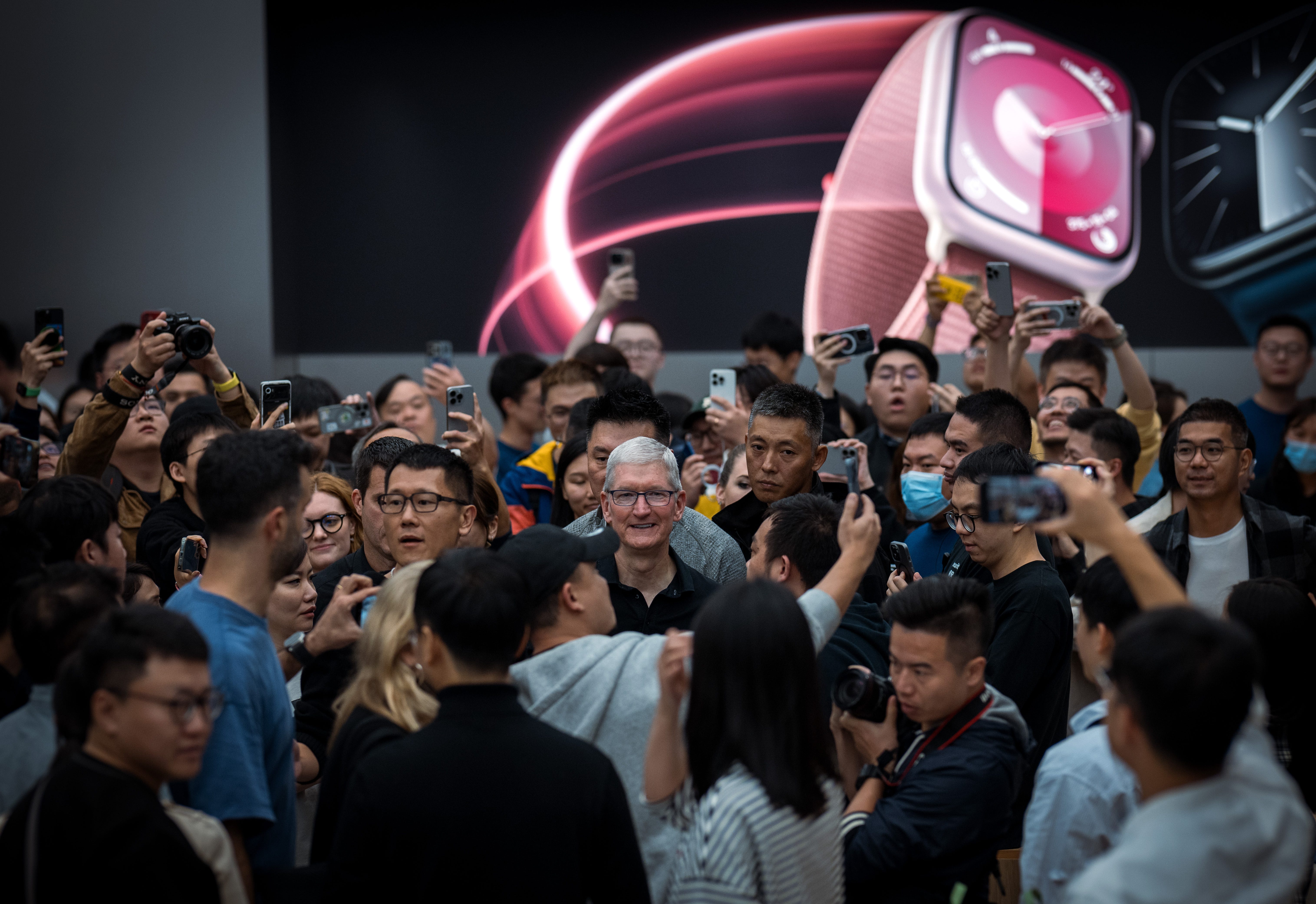
Solitary, poor, nasty, brutish, and short … but enriching someday
For all of the talk about China in these four works, it’s the brutal working conditions at Apple that surprised me the most. McGee never makes the analogy, but Steve Jobs’s turnaround of Apple in the late 1990s and early 2000s is reminiscent of Mao’s Long March, when tens of thousands of communists trudged more than 6,000 miles to Yan’an to escape Chiang Kai-shek’s Nationalist forces. Jobs exacted a high toll from his workforce in order to engineer the magic of iPhone to the ultimate delight of billions of owners as well as the company’s shareholders, as McGee relates:
The eighty-hour workweeks and increasing need to be in Asia at inconsistent times, with little warning and often for unknown durations, caused massive stress on the engineers’ mental health and their marriages. They were primarily men, and some of their wives took to calling themselves “Apple widows” because their husbands were around so infrequently.
Apple’s elegant solution was giving workers a day off through what was informally dubbed the “Divorce Avoidance Program.” But a day off was a day the company ultimately couldn’t afford:
The necessity of giving engineers respite to save their marriages was understood, but with Apple’s [Industrial Design] studio continuing to push the boundaries of what was possible, workers were under constant pressure to perform. So instead of giving time off, Apple started to give out bonuses meant to assuage spouses.
These bonuses were dubbed “Danny bucks” for the company’s VP of Product Design Dan Riccio (If you would like to supply me with some Danny bucks, all channels are open).
What was the cost of Apple’s Long March?
Some Apple engineers can even rattle off the names of people who died on the production line or upon their return from yet another trip to Asia. The engineers were often in their forties or fifties, and while it’s not possible to conclude that overwork was their cause of death, many believe it was. One longtime veteran recalls that, during the funeral for one of these people, the number of Apple employees who left the Sunday service to join conference calls was unbelievable.
Jobs himself attributed his pancreatic cancer to overwork. That was the cost. The benefit, of course, is known to all of us: the once “beleaguered” and nearly bankrupt computer maker rose like a phoenix to become the second most-valuable company in the world after Nvidia, last year producing revenues of $416.2 billion on the backs of 166,000 employees, or roughly $2.5 million a soul.
McGee’s thesis in Apple in China is that those 166,000 employees didn’t act alone, but instead tutored millions of laborers in China and throughout East Asia to manufacture components and assemble them into awe-inspiring devices. As he writes early on, “It’s not merely that Apple has exploited Chinese workers, it’s that Beijing has allowed Apple to exploit its workers, so that China can in turn exploit Apple.”
Apple was perfectionist. Unlike competitors, it decided to scan every iPhone coming off the assembly line for defects, rather than just a limited random sample. That demand required completely rebuilding the supply chain for RF frequency testing machines, a niche industry that produced a small number of devices for laboratory usage, not the quantities needed for scaled production. Apple dispatched its engineers to teach the companies how to produce more machines.
Xiao Hai, a pen name for an itinerant laborer-cum-poet Hu Liushuai, suffered a spell at a Foxconn factory on the receiving end of that perfectionism. He describes his experience in Adrift in the South:
The floor manager sent me and other newcomers across different work crews. At the time, Zone L was manufacturing the iPhone 7, and I was assigned to quality control. On my assembly line everyone’s workstations were separated by machines, and I couldn’t see the faces of my neighbours. My job was to pick up finished products from the conveyor belt, shove each of them in a drawer-like examination compartment, and wait for letters to appear on the screen. If the letters flashed green then it meant the phone had passed quality control, but if they were red then I’d need to return the phone for repair. It took about thirty seconds for the test to run, and each machine was built to have about a dozen examination compartments running at once. Whenever a screen flashed green I’d empty the drawer and fill it back up with another phone from the belt — the machine was never supposed to be empty, and neither were my hands.
In low season, shifts were merely monotonous, but the intensity ramped up dramatically with each new model launch. Ultimately, Foxconn’s goal was for each worker to become a cybernetic extension of the machine itself:
With all these machines around me, I felt as though I had passed into cyberspace. Shrouded tightly within my coverall gear, it was like I was an extension of my silicon-based companions. We were there simply for the sake of the products on the conveyor belts, and we all knew it. We had morning and evening meetings before and after our shifts, during which our higher-ups babbled on about production figures. There was nothing else. Nobody ever brought up their aspirations or what their lives were like outside the factory.
Xiao Hai does have ambitions though, and ultimately realizes them through his writing and poetry. He grew up in an impoverished village in Henan province, and was unable to attend high school because his parents couldn’t afford the fees for both his older brother and himself. So he sets out to find his livelihood and place in this world.
Like millions of other migrant laborers, his story is not one of Whiplash rags-to-greatness, but rather one of just scraping by and staying adrift. He makes money, quits, and loses his savings, time after time. His survival instincts kick in at just the right moments to keep him afloat. He doesn’t want to be a cybernetic extension of the machine, but there is no alternative, for that machine is the only thing writing a check that can buy him food. Outside of a short stint as a popcorn vendor, the factories are where his livelihood comes from until he moves to a creative urban village outside Beijing called Picun, where he finds solace if not wealth
.
The same can’t be said for Ren Zhengfei, the founder of Huawei, who does manage to find both even if the search is ultimately killing him. In House of Huawei, Dou recounts discussions over Ren’s succession back in 2011. “Without offering details, Ren also disclosed that he’d had two cancer surgeries over the years. He blamed it in part on overwork: ‘I was too tired. My body just collapsed from fatigue.’”
Ren assiduously tries to cover up his emerging wealth in China, just as he tries to hide many details of his biography and the company’s history. When Forbes identified him as China’s third-wealthiest individual in 2000, he was incensed. “Ren had not wanted to appear on the list. The Financial Times reported that Huawei had offered the list’s author, Rupert Hoogewerf, a factory tour if Ren could be omitted.” His ranking made him a target, and in the lawless competition of China’s tech scene, being a target meant being prey rather than the “wolf” that Ren tried to inculcate in each of his employees.
Indeed, working at Huawei was grueling, at times an almost perfect mirror of McGee’s Apple. Huawei employees were committing suicide due to overwork:
In June 2007 … [Ren] wrote that he was at his wit’s end about stopping the deaths among his employees. “Huawei continues to have employees committing suicide and self-harm,” Ren said. “And the number of employees suffering from depression and anxiety is increasing, which is very worrying. Is there any way to help employees face life positively, openly, and uprightly? I’ve thought about it again and again, and I can’t solve it.”
As Dou makes clear, Ren built Huawei like an army, in which suffering and self-sacrifice were fundamental in the war for national rejuvenation. In the company’s early and impoverished era, engineers building the country’s first indigenous phone switches worked without air conditioning or mosquito nets, even in the tropical summers of south China.
Ren was Fletcher conducting to the highest standards. It was hell, but no alternative was on hand. He bought employee loyalty through stock, which paid dividends in Huawei’s good years, but there was no broader safety net. When China passed a law that offered some job protections to workers based on seniority, Ren acted fast:
Huawei had long had a reputation for laying off older engineers to keep its salary costs lower with a younger staff. Now, in late 2007, Huawei rushed to get ahead of the new law. With Ren taking the lead himself, some sixty-five hundred Huawei employees resigned and rejoined the company, wiping out their seniority.
Seniority, of course, assumes one can stay with the same employer. That notion doesn’t apply to millions of migrant laborers, who are constantly shifting around based on market demands and their own desires. Hu (also a pen name) describes his eclectic roles across China’s gig economy in I Deliver Parcels in Beijing. Mostly eschewing factory work, he instead pursues his livelihood as a deliveryman for ecommerce companies with stints at a diverse set of other jobs. The spare narrative is the tick-tock of gig work, with sections like, “My Sixteenth Job to My Nineteenth.”
Hu’s memoir is an anthropological look at the intricacies of modern capitalism. Deliverymen in China are paid per parcel, and so all sorts of calculations and tradeoffs are made by laborers. Is it better to work in a far-flung neighborhood with nicer residents that are easier to deliver to, or a denser neighborhood of arrogant residents who often create more hassle? Is the payoff of upgrading a bike’s motor covered by increased efficiency?
Relative power could shift in an instant, and Hu becomes attuned to these fleeting moments of agency. “One of the longer-time couriers joked on the down-low that the leadership loved to whip us into doing our jobs in the less-busy times, but when the sales came around, they were on their knees begging for us to stay. It was also the only time when we could request change of any sort, and they would respond promptly.”
His story is more sanguine and filled with less angst than Xiao Hai’s. Whether the difference comes from personality or the depersonalization of factory work, I haven’t a clue. But Hu is a man who knows that he has to keep on going, even if he feels it’s futile. “I have never believed in karma. Some things just seem to be fated, when really there are underlying patterns at work. That is why I should have known that, just as our new store was thriving, the seeds of trouble had already taken root.”
Those “underlying patterns at work” are, frankly, the textures of development. Even today, China struggles with prodigious — and under-reported — levels of unemployment, particularly among youth. Millions of college graduates are struggling to land a quality job, or even one that offers them survival in the country’s cutthroat economy. The whiplash of development is that even as these graduates pursue their studies further than their parents could ever have dreamed, the opportunities before them seem ever more distant. Many talk about involution, or reverse evolution.
Civilization’s long march, in short, never stops. The depravities of generations past resurrect themselves as new monsters to be overcome in the present. Millions more Chinese have walked into the elite strata of global power, but there are still more than a billion others behind them, waiting their turn.
Was it worth it? Yes. Unequivocally so. The despair and agonies of the poverty described early on by both Hu and Xiao Hai should remind all readers that no one wants to live their lives; the two only do so because they have to. But what are we to make of the Apple engineers ensconced in a spaceship ring in Cupertino, designing every last chamfer and Liquid Glass raytrace to perfection? Or the Huawei engineers wolfishly securing 6G patents as their company seeks to secure the next generation of wireless technology?
They just keep going, wealth or no. Similar to my comments on Kim Jong-un last week on North Korea’s nuclear program, sometimes the only way to succeed is the Whiplash way. Mission, hubris, arrogance, stubbornness or plain old stupidity — pick your human fault. Certainly the subjects of our four books did. It’d be career suicide to ever stop.
Don’t let your schooling interfere with your education
Learning is the lifeblood of development, for startup founders and nations alike. Hard work is clearly necessary, but not sufficient. In a complex material world where producing an iPhone takes millions of workers, from the coltan miners of the Congo to the assembly workers in Guangzhou, the ferocious pursuit of knowledge is the key activity for building wealth.
The challenge for China has not been a lack of desire to learn, but a lack of teaching. During the Cultural Revolution, teachers were denounced, universities were closed and education was replaced with labor in the countryside. Ren of Huawei suffered mightily in this period, but lucked out in being assigned to a military outpost where he could practice engineering and bide his time until Mao died in 1976. That early luck would reverse during the more recent degradation of U.S.-Chinese relations, when his military past became far more ominous to American policymakers.
Who would teach China as it emerged from Mao’s hell? McGee’s argument is simple: China’s teacher was Apple, full stop.
Journalists have covered Apple’s forays in China for decades. Allergic to a well-tread story, McGee advances the reporting by arguing that Apple didn’t just take advantage of Foxconn’s scale, but offered lavish support for training Chinese engineers and line workers to build its ambitious devices:
The explicit deal—let’s call it the Apple Squeeze—was that Apple’s engineering and operations teams would rigorously train local partners, in the process giving away manufacturing knowledge, in particular how to efficiently scale while maintaining the highest quality standards. In exchange, the local supplier would work for soul-crushingly low margins with the understanding that it could profit from the incredible volumes Apple demanded.
What made Apple unique in the Chinese market is that its novel designs for the iPhone and other devices required pathbreaking innovation in manufacturing — work that had never been done before, let alone at scale. Apple wasn’t just offering business to millions of Chinese workers like, say, Walmart, but was teaching them how to do some of the most complex work in the world:
Wanting to help Apple understand its predicament in China, [Doug] Guthrie started traveling and interviewing suppliers. In his talks with dozens of them, a common theme emerged. “Working with Apple is really fucking hard,” suppliers would tell him. He’d respond: “So don’t.” And they would demur: “We can’t. We learn so much.” … Apple gravitated toward quality, not price. To reach that quality, Apple had to come up with new processes to make the phones; but until Apple developed a new design these processes wouldn’t exist. So it had to work far more intimately with suppliers.
Apple was the Fletcher for Chinese suppliers. It was an absolute monster of a partner, often demanding the impossible, and at extraordinarily cheap costs that forced suppliers to cut wages to the minimum. But it got what it wanted, and the workforces implanted at factories across China learned differentiated skills that made them competitive in the global marketplace. Apple was an abusive teacher; it was also the best teacher a country could have hoped for.
Dou’s Huawei story runs parallel, but from an indigenous perspective. A thirst for learning was fundamental to how Ren conceived of the foot soldiers of his telecom army:
Ren thought of Huawei’s staff as more than just dumb money. He pushed them to cultivate themselves. He felt that the Huawei man should be a Renaissance man, learned in history, literature, philosophy, and global cultures.
That cultivation extended to the built environment. He wound up constructing an extraordinary headquarters campus for the company, including a replica of Versailles and a dozen more neighborhoods that riffed on diverse Western architectural styles. The company’s data centers were no exception. Huawei’s massive center in Guizhou province is broken up into several buildings designed to emulate a European market town. (One wonders whether the AI backlash in America would be so severe with such grandiose architecture instead of the boxy modernist dreck we see here, but I digress).
Learning could be done by doing, but Huawei’s early products didn’t match the quality of its Western competitors and found little purchase in developed countries. So it sought experience by operating in the world’s most inhospitable locations, ranging from Iran and North Korea to some of the most turbulent countries of the Middle East. Ren’s army would persist:
During his visits to Iraq, Afghanistan, Libya, and Mali, Ren told Huawei employees that while he sympathized with family members’ concerns over their safety, they couldn’t leave their posts without properly handing off their work. … “Huawei might be the only foreign company remaining there [in Libya],” a Chinese newspaper reported.
Whatever it took, it got done. Huawei’s journey from its humble origins to number one telecom equipment provider was a harsh road, but it reached its destination.
For all of the hours and abuse, did the lessons stick? For Hu and Xiao Hai, it’s not at all clear. Hu’s gig work doesn’t lead to any personal development, other than memorizing street addresses and optimizing his route. Whether he’s working for one logistics company or another, the packages are packages, and no amount of tacit knowledge can overcome the structural mindlessness of the work. Hu later experiences a respite from the intense competition in logistics while working in mall security:
Life in Xiaguan was good. Although I wasn’t making all that much, I never had to work more than eight hours a day. The job also fell well within my capabilities, which was a relief. Everyone there treated me really nicely, sometimes to the extent I felt like a foreign guest. Maybe this was because I was the only employee from outside the province.
We can relax as readers in these tranquil moments, but Hu ultimately can’t. Across 18 jobs, his income has barely budged, and it wavers with every twitch of global macro conditions. He’s hanging on, not getting ahead — or propelling the country forward. He’s locked in a cycle of poverty with no exit.
Xiao Hai experiences a bit more development through his factory work. Quality control of iPhones aside, he eventually accrues a series of textile skills that allow him to secure slightly better jobs with higher-end employers. But the work is still endlessly tedious:
I toiled away. My days were an agony. The overheating machines were all wired to each other, their buzz resonating from morning to night, drowning out every other sound across the production floors. … All the sewing I was doing left my muscles and bones aching and I felt burned out in no time. … Working like I was working, there was no way to see the light at the end of the tunnel. Every day was the same: a movement between my dorm, workstation, the cafeteria, and then back to the dorm.
His work produces income and keeps the machine going, but ultimately, he gains no leverage from his arduous exertions. There’s a ceiling on sewing that comes sooner rather than later. This isn’t Fletcher on the podium demanding higher standards toward a world-class career, but something much more base, the repetitive orchestrations required by the machine. He is the man captured by China’s development statistics, accumulating a few skills when he can and always working tirelessly, one shift at a time. Was there ever a path toward something better?
The myths that keep us going
Albert Camus’s The Myth of Sisyphus envisions the titular king pushing his boulder up a mountain again and again, coming to appreciate the suffering and futility of that punishing ascent as the meaning of life, discarding the “philosophical suicide” of disbelief in God in the process. The more optimistic industrial policy version is pushing the boulder and suffering tremendously so that one day, future generations can purchase a bulldozer and do the labor mechanically.
What these four books on China show is that there is a path forward toward development and wealth, one filled with hardship but also hope and a steady accumulation of expanding power. It can be done. In fact, it has been done, many times before. The labor history of Great Britain and America during the Industrial Revolution equally matches — and may even exceed — the deprivations described in these works. Sweat and blood are the roots of progress.
The challenge for China and the West today is that development and growth isn’t a destination, but a neverending process. Hundreds of millions in both places are still waiting for their turn at fortune. The two truths — hard work and learning — are as easy as ever, and yet, the compulsion to compete and push forward is reversing.
This week, we learned the United Kingdom is getting its seventh prime minister in ten years. All of them avoid telling it like it is, of what it will take for Britain to come back. After all, that would be career suicide. Yet, the only Whiplash worse than striving for greatness is the abusive hell of the decline.
Postscript: The mechanics of impossible sourcing
I loved all four books on their own merits, but they are even better in dialogue with each other. There’s real Riskgaming-esque leverage from understanding the tradeoffs that different people make in the same context. That said, as a former journalist and editor, I had many thoughts on the construction of these books.
McGee’s Apple in China has its fair share of weaknesses. He covers decades of corporate history, which makes the book feel both long and also too synoptic. His Long March of Apple product launches is exhausting, and I feel it is only included because of the stray useful source and the need for comprehensiveness. A deeper dive into a single product launch would have been far more useful to understand the nuances of how learning got transferred from Apple to China.
More despairingly, Foxconn’s role in the story is shockingly minimized. McGee is shrewd, and writes in his acknowledgements that “As authoritative as I hope this work is, the Apple-China relationship alone is worth several more books. There is also far more to be researched and written about Foxconn…” Yet, his thesis is that China wouldn’t have developed without Apple as its teacher. But without Foxconn and its founder Terry Gou, Apple would never have been in China to begin with. Maybe it’s just turtles all the way down, but I found the relatively weak coverage of Foxconn to be a sore point to his narrative.
The upshot is that McGee has secured an incredible source in the form of John Ford, who led Apple retail in China for multiple years after the launch of the iPhone. McGee is a veteran journalist, and knows when he has struck source gold. These chapters are lengthy but are profoundly rich with texture on what it takes to run a foreign enterprise in a developing country like China. I would buy the book exclusively for this part.
Dou set herself up with a nearly impossible task covering Huawei’s history, given the company’s past opacity and the incredible scrutiny it faces today. I think she has done an admirable job of sleuthing and synthesizing the widest array of open-source material possible, coupled with a useful series of interviews that fleshed out the analysis.
Yet, her inculcated journalism values mars the direct judgment she could have offered in the book. She has this peculiar habit of pondering why certain facts aren’t presented truthfully, a sort of “it’s curious that” ethos that implies conclusions without indictment. In the strict ethics of a rigorous journalist, I understand the hesitation to call a spade a spade without a certificate from the Global Spade Alliance. But sometimes, you just … can. And should.
For Hu and Xiao Hai, I’m hyper-alert that we are getting their plucked-from-the-masses memoirs. Amidst hundreds of millions of floating laborers, here are two who have risen to such prominence in China that they have secured English translations and are now published globally. This is rarefied company. The existentialism of the two is by no means the norm across Chinese workers, who I imagine are less interested in writing poetry, but want to eat and fornicate more. Both authors constantly switch jobs out of tedium and boredom, but it is precisely that boredom that keeps many others fixed to their workstations, shift after shift.
Where the two works diverge is in their approach to life. Xiao Hai is trying to find his place, and eventually finds it with his writing career and a community of like-minded creatives. Hu, on the other hand, is struggling to just deal with a cruel world that never offers hope for a better life. It’s a hardscrabble story, and one that isn’t always sympathetic.
I do recommend these books be read together, perhaps with Dan Wang’s Breakneck throw in for good measure (Dan was on the Riskgaming podcast last year, so I didn’t thread his work into this essay as well). The story of hundreds of millions of people exiting poverty and entering the global middle class deserves many more retellings. We are still only getting started.
Also check out
Christian Keil at a16z says no amount of wishful thinking can keep us from having to fight a space war. He’s got ideas about learning how to win one.
Data centers use 0.2 percent of daily water usage in the U.S. and that number has actually decreased in the past few years.
Eli Lilly gave exactly one patient “compassionate use” access to their very hyped and unapproved GLP-1 retatrutide. Looks likely that person was Trump.
A long and surprising history of plagiarism—from Shakespeare to Biden, Nabokov to Dylan—that asks whether nearly all writing is, in some sense, theft.
Michael Koffman assesses Moscow’s military power after Ukraine.
Big AI labs are hiring lots of philosophers. Why?
Rheinmetall gambled on Germany’s doomed warship project, and lost. Here’s what happened.
And The Economist is skeptical about Andy Burnham. Are we already heading to our eighth UK Prime Minister in 10 years?
Really enjoying the new format. The depth here is super impressive. I don’t know how you write these at this pace!
Really enjoyed this. Reminds me of something I’d read in NYRB. Thank you.